


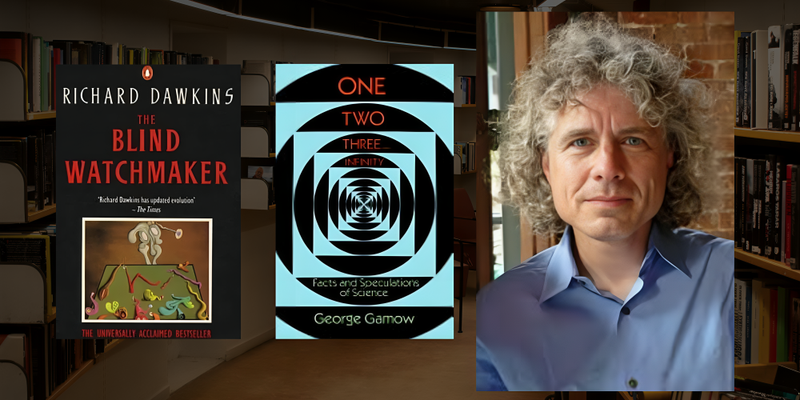
Books That Change Perspectives: Insights from Steven Pinker
Books that shape our understanding of the world can profoundly influence how we see ourselves and our surroundings. Steven Pinker, the esteemed cognitive psychologist and linguist, has identified five books that he believes can shift perspectives and enhance thinking.
1. One, Two, Three…Infinity by George Gamow
The classic title One, Two, Three…Infinity, first published in 1947, remains an essential work in scientific literature. Written by physicist George Gamow, the book provides an entertaining journey through mathematics, cosmology, and atomic physics. Gamow employs a humorous narrative to explore concepts like the paradoxes of infinity and early ideas related to the Big Bang theory. This book is recommended for its ability to distil profound scientific concepts into accessible language for general readers.
2. The Selfish Gene and The Blind Watchmaker by Richard Dawkins
Richard Dawkins’ The Selfish Gene, published in 1976, revolutionised thoughts on evolution by proposing that genes are the main agents of evolutionary change. Dawkins explains how complex behaviours, such as altruism, can stem from self-replicating molecules. In his subsequent work, The Blind Watchmaker (1986), he expands on this idea, countering the argument for intelligent design with evidence showing how natural selection can create intricately designed structures over time. These two important texts are vital for anyone wishing to grasp the complexities of life and evolution.
3. The Big Picture: On the Origins of Life, Meaning, and the Universe Itself by Sean M. Carroll
In The Big Picture, theoretical physicist Sean Carroll offers a comprehensive view of the universe through the lens of modern science. He presents the idea of poetic naturalism, which suggests that concepts like life, consciousness, and meaning can be understood through the laws of physics, without resorting to supernatural explanations. Carroll adeptly links quantum mechanics with existential questions about the nature of morality and purpose, making this an ideal read for those keen to delve into life’s profound mysteries from a scientific standpoint.
4. The Beginning of Infinity by David Deutsch
In The Beginning of Infinity, David Deutsch, a pioneer in the field of quantum computing, embarks on a daring examination of knowledge, progress, and reality. He contends that human understanding and potential are boundless. The book navigates through various domains, including physics, philosophy, and politics, and advocates for the significance of good explanations in understanding knowledge. Deutsch challenges prevalent misconceptions about science and societal progress, emphasising that through rational inquiry, humanity can perpetually expand its comprehension and enhance existence.
These books, as recommended by Steven Pinker, offer more than mere entertainment; they serve as gateways to consider challenging ideas that expand viewpoints and deepen understanding of the reality around us.