


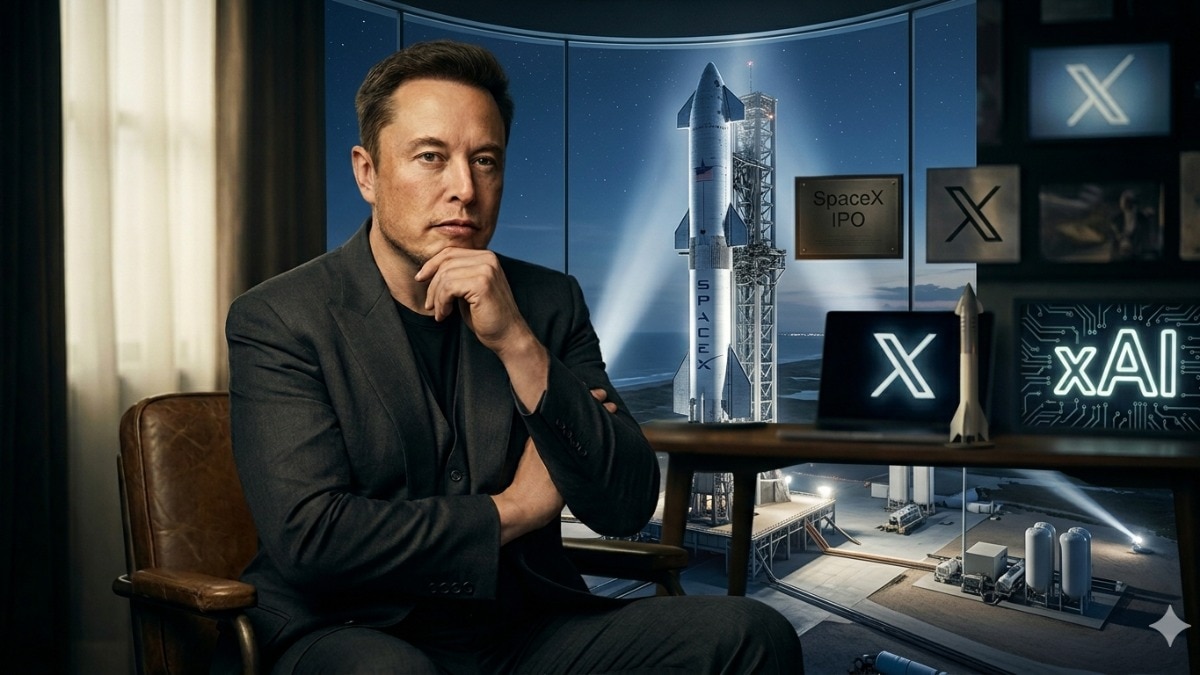
SpaceX IPO marks a significant leap in Elon Musk’s vision for the “muskonomy,” which encompasses a diverse array of initiatives, including Tesla, The Boring Company, xAI, and Neuralink. The company’s confidential filing for what may emerge as the largest initial public offering in history is not merely about a spectacular market introduction; it highlights a strategic move to reshape investment dynamics across various sectors.
With ambitions to garner more than $75 billion and achieve a valuation that might exceed $1.75 trillion—outpacing the record previously held by Saudi Aramco—this listing has the potential to revolutionise financial flows into space exploration, artificial intelligence, and next-generation infrastructure. It also provides SpaceX with the crucial resources to broaden its scope beyond just rockets and satellites, helping to forge a more cohesive technological ecosystem.
How Soon Can SpaceX Go Public?
SpaceX has commenced its filing process with US regulatory bodies. The company now enters a review phase that is projected to last between 45 and 75 days, during which government agencies may offer feedback requiring adjustments.
Subsequently, the official documents will be unveiled and presented to investors. Based on current timelines and predictions, SpaceX might be on track to go public as early as June 2026.
How SpaceX IPO Enhances Musk’s Vision of the Muskonomy
SpaceX is progressively extending its influence in the fields of space, technology, and artificial intelligence, evolving into more than just a rocket company. It has established itself as a key player in US space missions and holds multiple significant government contracts.
Despite its wide-ranging services, the bulk of SpaceX’s revenue is generated through its satellite internet platform, Starlink. The acquisition of xAI, which supports Musk’s AI startup and its Grok chatbot, has further consolidated his leadership across rockets, satellites, and AI under one overarching umbrella, thereby reinforcing the “muskonomy.”
How Will SpaceX’s IPO Support Its Aspirations?
Although SpaceX already enjoys substantial revenues, its impending IPO stands to offer the financial backing necessary for large-scale initiatives, including the development of Starship. This next-generation rocket aims to facilitate missions to the Moon and Mars—endeavours that demand significant financial investment and could take years to achieve.
The company also envisions constructing orbital infrastructure, like data centres in space. With xAI now part of its portfolio, additional funds will be essential to develop advanced AI models that necessitate vast computational resources. Predictions indicate that the AI sector could be facing monthly expenses nearing $1 billion.
Going public will allow SpaceX to tap into much larger financial reservoirs, thus better positioning itself against AI competitors such as OpenAI and Anthropic.
The Rationale Behind the IPO
The public offering will provide SpaceX with fresh capital while also offering publicly traded shares that can be leveraged for partnerships, agreements, and employee incentives. Previously, the company relied on private funding from major investors.
Reports indicate that SpaceX intends to implement a dual-class share structure, enabling insiders, including Musk, to retain substantial control over the company post-IPO, a model already adopted by many leading tech firms.