


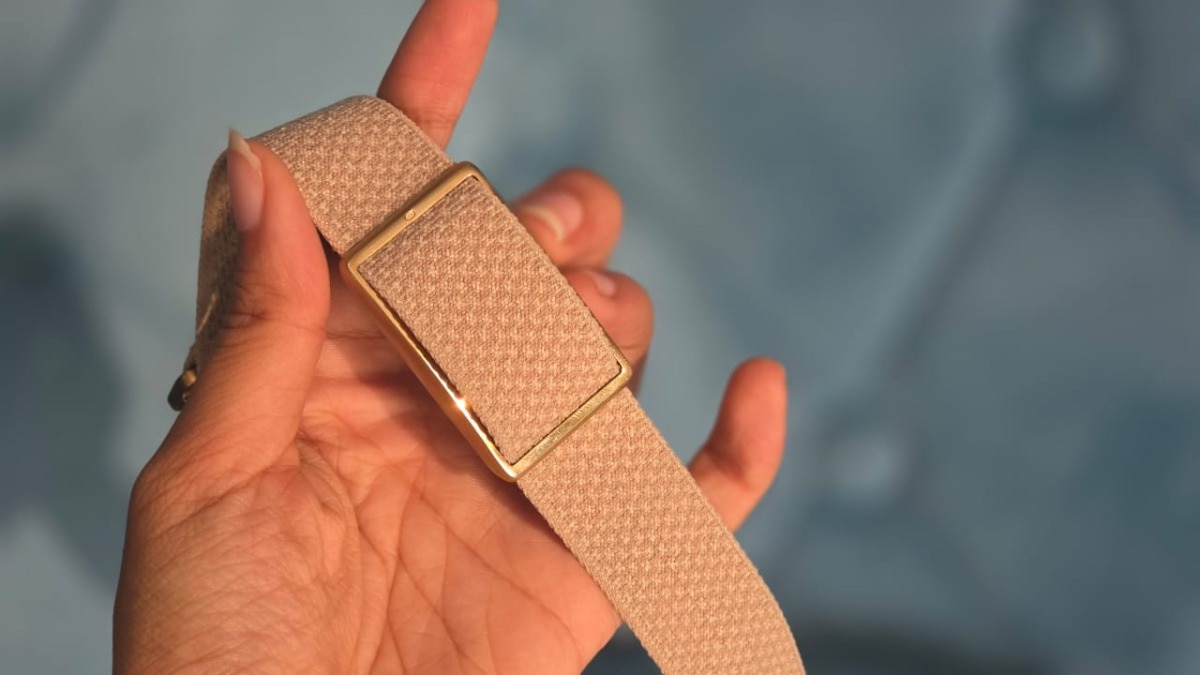
The Polar Loop stands out in the fitness tracker market, moving beyond bulky smartwatches that are often filled with intricate features. Recently, sleek and minimalist fitness bands have captured the attention of users preferring a simplified experience on their wrists.
Retailing at Rs 19,999, the Polar Loop emerges as a notable contender in this arena. With smartwatches offering capabilities such as heart rate monitoring, workout maps, breathing reminders, and personalised advice, it is essential to evaluate whether a minimalist band with basic activity tracking is worth its price.
The Polar Loop has been evaluated over a period of more than 15 days to understand its operational effectiveness and its impact on fitness tracking relative to smartwatches.
Aesthetically Minimalistic Design
The Polar Loop serves as a budget-friendly option compared to the much-publicised Whoop band. From a design perspective, the Loop shares similarities with Whoop’s offerings, featuring no display, a rectangular sensor unit, and a strap that wraps neatly around the wrist.
Despite these resemblances, the Polar Loop introduces unique elements that may capture user interest. The strap, made of soft fabric, provides comfort against the skin, while the sleek sensor unit remains discreet. Weighing just 29 grams, it is notably lightweight.
The Loop employs a velcro-style closure, allowing for easy adjustments without the hassle of buckles or clasps. Essentially, it feels like nothing is being worn, particularly during sleep, which can be uncomfortable for many who wear smartwatches at night.
Visible on the back of the sensor unit are blinking LEDs and a magnetic charging port. In conclusion, the Polar Loop boasts a minimalist yet visually appealing design suitable for daily wear.
Features and Performance
Given that the Polar Loop lacks a screen, it relies on the Polar app for tracking fitness metrics, encompassing steps taken, calories burned, sleep quality, and heart rate data. Moreover, it features automatic training tracking for activities such as running. This means it’s not necessary to manually initiate a session every time. Additionally, the Loop tracks sleep patterns, offering insights into light, deep, and interrupted sleep. During the night, it monitors heart rate, HRV, and breathing, providing a comprehensive sleep score. However, while the features seem compelling, the accuracy of the tracking can occasionally fluctuate.
In terms of step and calorie count, the data aligned closely with what was recorded by an iPhone. Testing the heart rate against a smartwatch yielded similar results. However, initial sleep tracking presented challenges.
The Loop’s approach to tracking sleep had inconsistencies worth noting. It begins recording as soon as the user lies down, struggling to differentiate between actual sleep and simply remaining still, like reading in bed. On several occasions, deep sleep was registered during wakeful periods, raising concerns about its precision.
Regarding sleep scores, maintaining a rating between 6 to 8 out of 10 was achieved, which is perceived as acceptable.
Polar App: Functional yet Non-Intuitive
The Polar app integrates all performance data, including activity, sleep, and heart rate metrics. However, the user experience does not consistently reflect the quality of the hardware it supports.
A noticeable drawback is that the app requires approximately a minute to sync data from the band, meaning users must wait to access the latest information. Additionally, navigation within the app can feel cumbersome, requiring several taps to reach daily data, which might prove frustrating.
Battery Life
The Polar Loop is powered by a 170mAh battery, with claims of lasting up to 8 days. However, real-world usage shows the band typically lasts around 6 days on a full charge. Users receive an alert via notification when the battery drops below 20%. The Loop requires approximately 1 hour and 45 minutes for a full charge, making it a relatively quick charging option within its category.
Polar Loop: Overall Analysis
The Polar Loop effectively captures an appealing aesthetic while handling the essentials well. Its lightweight structure, comfortable fit, and minimal distractions provide a refreshing alternative in a landscape dominated by feature-laden smartwatches. For those looking to shift away from overloaded smartwatches to a lighter and more straightforward solution, it delivers on that front.
Regardless, issues like inconsistent sleep tracking, a sluggish syncing app, and navigation challenges may be difficult to overlook at a price point of Rs 19,999. Consequently, the Loop finds itself within a highly competitive price range, as users might anticipate greater consistency in performance.