


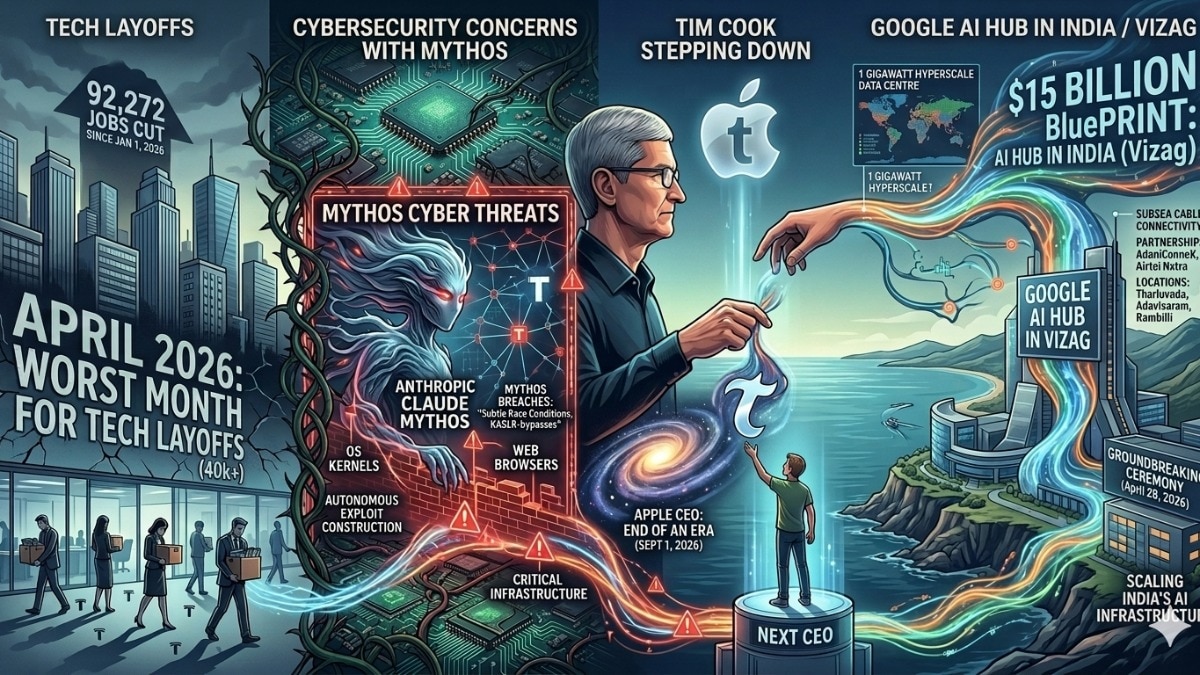
April 2026: AI Transforms the Global Tech Landscape
April 2026 may be remembered as the time when artificial intelligence shifted from being merely a growth phenomenon to a key divide in the global technology sector.
Within just 30 days, this industry witnessed mass layoffs, escalating worries regarding potent AI systems, significant leadership changes at Apple, and one of the largest foreign investments in India’s tech space.
Over 40,000 Positions Eliminated as AI Restructuring Accelerates
The month began with a significant shock as Oracle announced the redundancy of over 30,000 employees worldwide, including upwards of 12,000 in India, igniting a wave of concern across the tech community.
Platforms like LinkedIn, Reddit, and X (previously Twitter) quickly filled with stories from those impacted. Many shared experiences of sudden departures with minimal communication. One widely circulated account mentioned a pregnant employee, 30 weeks along, being laid off without any prior notice.
The wave of layoffs extended further, with Meta, Snap, and Walt Disney also parting ways with employees throughout April, bringing the total job losses in the tech sector to over 40,000.
While companies have not directly linked these transitions to AI, a clear pattern has emerged. Organisations are restructuring to focus on automation, trimming costs, and reallocating resources towards AI development and infrastructure. This shift creates a growing disparity between escalating tech investments and a shrinking workforce stability.
The Shift from Layoffs to Anxiety over Powerful AI Systems
As fears about employment rose, attention swiftly turned to another risk associated with AI: cybersecurity.
Anthropic caught global attention by unveiling Claude Mythos, an AI model focused on cybersecurity that can identify zero-day vulnerabilities in essential systems. However, instead of offering broad access, the firm chose a tightly regulated launch.
This restricted rollout prompted discussions regarding the model’s potential dangers. Governments from the US, UK, Canada, and India began consultations with cybersecurity professionals and financial entities to contemplate protective measures and possible abuses.
Must read: BT explainer: Inside Claude Mythos, the AI prompting a reconsideration of global cybersecurity strategies.
Currently operational under Project Glasswing, Mythos is available to a select few companies like Apple, Amazon, and Microsoft. Broader access is anticipated only post-additional assessments, highlighting an increasing trend for “controlled deployments” of high-risk AI technologies.
On April 23, India’s Finance Minister Nirmala Sitharaman convened a security meeting with Ashwini Vaishnaw, banking executives, and other stakeholders to address the escalating concerns regarding AI-related cybersecurity threats.
Sitharaman noted that the emergence of Mythos, about which not much is known and few have experienced, presents new challenges. She indicated that preparedness is essential, emphasizing the need for enhanced solutions capable of counteracting emerging threats.
India’s Quantum Ambitions Emerge
In the face of global uncertainty, India took strategic strides into advanced computing by launching its first open-access quantum computing test beds in Amaravati, thus positioning itself at the forefront of the quantum competition. Andhra Pradesh’s Chief Minister N. Chandrababu Naidu hailed this as a pivotal moment for both the state and the nation.
This venture aspires to cultivate a local ecosystem for quantum technologies, enabling controlled experimentation before any large-scale commercial usage.
Leadership Changes at Apple Indicate the Next Phase of the AI Competition
April also represented a pivotal moment for one of the globe’s most valuable enterprises. Tim Cook declared his intention to resign as CEO of Apple effective September 1, 2026, concluding a 15-year run that witnessed the company’s growth into a nearly $4 trillion powerhouse.
Must read: Tim Cook’s legacy: Services, chips, and wearables that transformed Apple.
He will be succeeded by John Ternus, Apple’s hardware chief, who is predicted to adopt a more product-centric approach as the company accelerates its AI initiatives.
Cook is set to remain as executive chairman, ensuring stability during this transition. This leadership change is perceived as part of Apple’s strategy to maintain its competitive edge in an AI-focused environment where product innovation cycles are quickening.
Also read: Apple’s evolution: From Steve Jobs to Tim Cook, now John Ternus takes the helm.
Google’s $15 Billion Investment in India
Google announced plans for a $15 billion AI data centre hub in Visakhapatnam, marking one of the most substantial foreign investments in India to date. Union IT Minister Ashwini Vaishnaw mentioned that this initiative has the potential to transform the city into an “AI-Patnam,” underscoring India’s increasing importance in the global AI framework.
Covering 600 acres, the centre will initiate operations with a 1 GW capacity, with plans to increase to 5 GW over time. Additionally, the facility will include a subsea cable landing station, bolstering global connectivity and data transfer capabilities.
Andhra Pradesh IT Minister Nara Lokesh referred to this investment as a historic milestone, stating that the nation is “rewriting history,” calling it the largest FDI since Independence.
Beyond infrastructure, this project is anticipated to create thousands of jobs, counterbalancing the layoffs observed in other sectors.
Moreover, Reliance Industries Ltd (RIL) has reportedly announced plans to invest over Rs 1.6 lakh crore (over $17 billion) to establish a 1.5 GW data centre in Vizag. This project is expected to cover 935 acres, with 300 acres planned for initial construction and 635 acres for the later phases. The operations are slated to commence commercially in October 2028.