


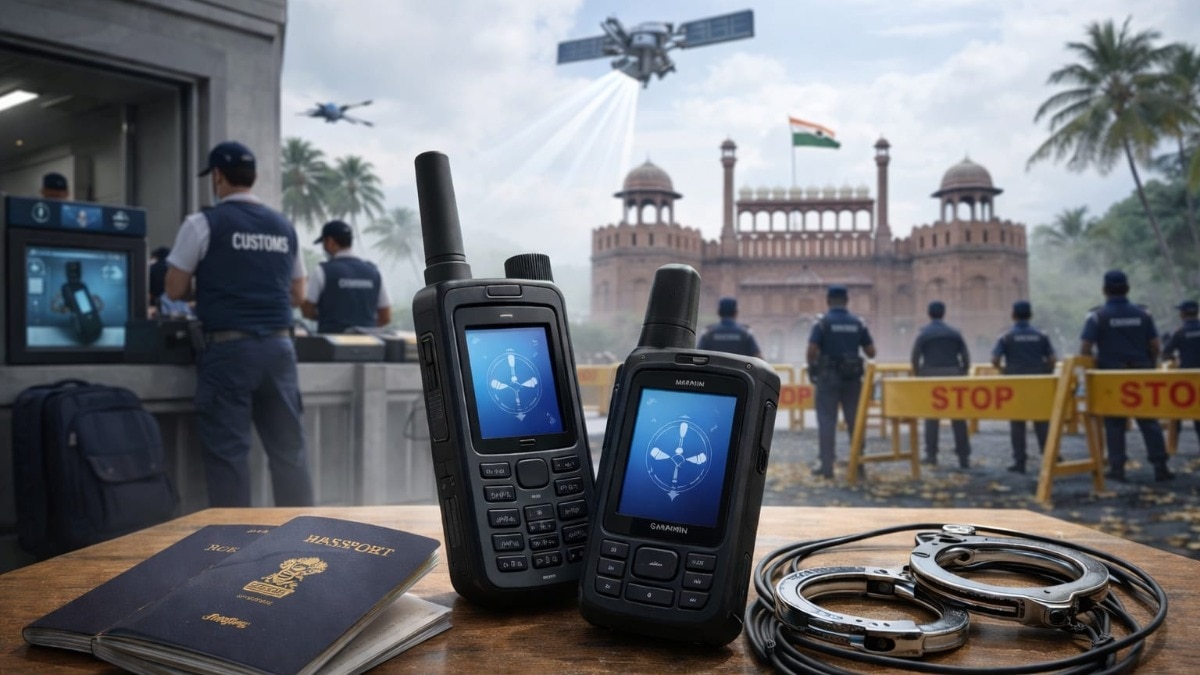
Satellite Phone Regulations in India
A satellite phone can operate anywhere, whether at sea or on the tallest peaks, but in India, using one without the necessary permissions can lead to significant consequences.
While not explicitly illegal, the use of these devices is among the most stringently regulated in the nation’s telecom sector, influenced by security issues, historical terrorist activities, and the difficulties in monitoring communication that occurs outside traditional networks.
Not Banned, But Stringently Controlled
Satellite phones are not entirely forbidden in India, but their usage is subject to strict regulations under the Telecommunications Act, 2023. Legal operation requires prior approval, such as a licence or a No Objection Certificate (NOC) issued by the Department of Telecommunications (DoT).
Even when permissions are granted, only certain services are permissible. In practice, satellite connectivity via BSNL linked to Inmarsat is allowed under tight conditions. Other international networks, including Thuraya and Iridium, are not allowed in India.
Any satellite phone entering the country must be declared at customs and supported by prior approval. Noncompliance may lead to confiscation, fines, or arrest. Multiple foreign governments, including those of the United States, have issued warnings advising their citizens against bringing such devices into India without appropriate clearances.
It is important to note that the regulations apply equally to both Indian citizens and international visitors.
Reasons for Strict Controls on Satellite Phones in India
The restrictions primarily arise from national security considerations. Satellite phones operate independently from conventional telecom infrastructures, enabling them to circumvent standard monitoring systems used by law enforcement.
This creates a significant gap for intelligence gathering, especially in sensitive areas like Jammu and Kashmir.
The regulatory measures became much tougher after the 2008 Mumbai attacks, during which terrorists utilised Thuraya satellite phones to communicate with handlers outside India.
In recent events, following the Pahalgam attacks, Indian security agencies investigated the suspected use of a Huawei satellite-enabled smartphone. Huawei, a Chinese firm banned in India, designs several smartphones with built-in satellite communication features, such as the Mate 60 Pro, P60 series, and nova 11 Ultra. These devices connect solely to China’s Tiantong-1 satellite network, overseen by China Telecom.
Must Read
A hidden Chinese Huawei phone surfaces in Pahalgam attack probe. Here’s what is known.
These smartphones come equipped with internal satellite antennas and specialised chips, allowing connections without external devices. Services necessitate China Telecom SIM cards and subscription plans. Intended for emergency situations, these smartphones offer basic voice and text functionalities, operating even where mobile networks are unavailable.
Legal Framework for Satellite Phones
Section 6 of The Indian Wireless Telegraphy Act, 1933:
It is illegal to possess “any wireless telegraphy apparatus, other than a wireless transmitter, in contravention of the provisions of section 3 [of the Act]”.
Section 3 of The Indian Wireless Telegraphy Act, 1933:
No individual shall hold wireless telegraphy apparatus” without a licence “except as specified by Section 4.
Section 4 of The Indian Wireless Telegraphy Act, 1933:
This section permits the central government to establish rules under the Act to: “exempt any individual or class of individuals from the provisions of this Act either generally or subject to specified conditions, or regarding certain wireless telegraphy apparatus”.
Operation of Satellite Phones
Unlike ordinary smartphones that depend on cellular towers, satellite phones connect directly to satellites orbiting the Earth. This direct connection allows them to function in regions devoid of traditional network infrastructure, such as remote mountains, deserts, or oceans.
Devices such as Garmin’s inReach utilise satellite networks like Iridium to send and receive messages even in the absence of mobile coverage. Because of their design, satellite phones are often bulkier and equipped with external antennas compared to modern smartphones.
Major global satellite service providers include Iridium, Inmarsat, Thuraya, and Globalstar, each offering different levels of global coverage.
Satellite Phones Compared to Smartphones
The primary distinction lies in their connectivity. Smartphones rely on terrestrial cell towers, which restrict their functionality in remote or uninhabited areas. Satellite phones, however, can communicate directly with satellites, granting them extensive coverage across various regions of the globe.
Some hybrid devices, like the Thuraya X5-Touch, offer both satellite and GSM/LTE functionalities, but such devices remain restricted in India unless explicitly approved.