
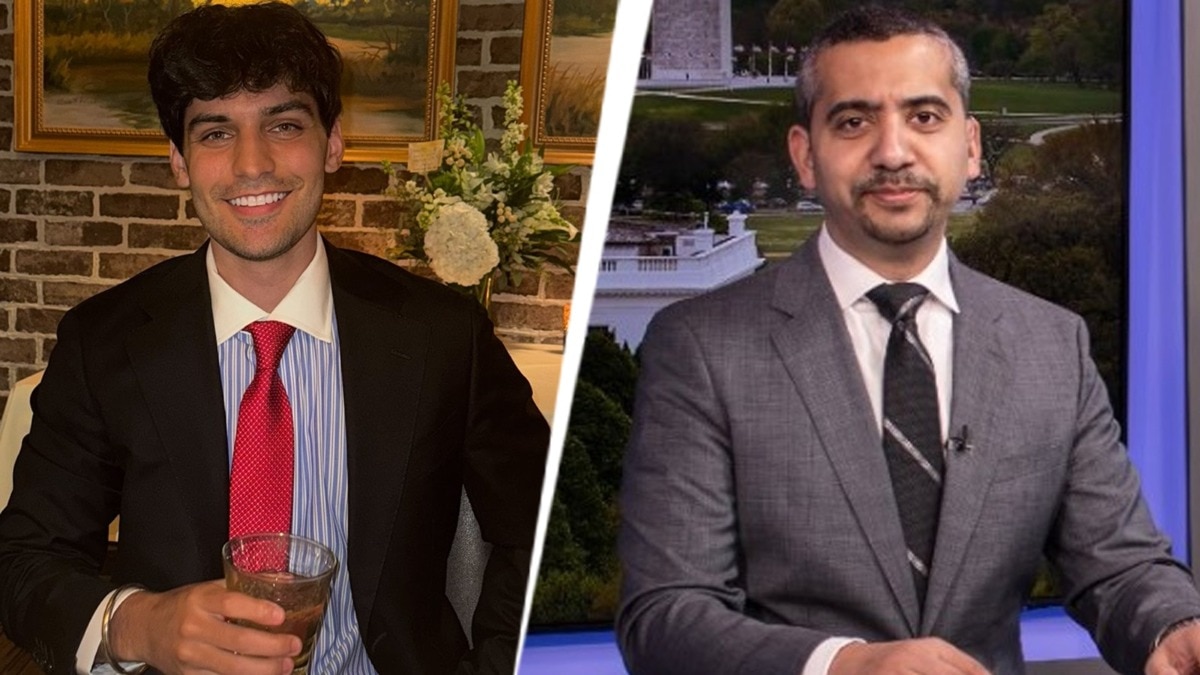
Immigration Debate Between Nalin Haley and Mehdi Hasan
The immigration debate gained momentum on social media, sparked by Nalin Haley, the 24-year-old son of Republican leader Nikki Haley, and British-American journalist Mehdi Hasan. This exchange highlighted the rising tensions in the United States concerning job opportunities, the impact of artificial intelligence, and the role of foreign workers.
The argument initiated when Nalin Haley took to X (formerly Twitter), calling for an end to mass immigration. He contended that overcrowding, a struggling economy, and the swift advancement of AI in the job market rendered it irresponsible to permit additional immigrants into the nation.
Nalin’s grandfather, Ajit Singh Randhawa, who was the late father of Nikki Haley, had faced similar unfounded anti-immigrant sentiments upon relocating to the US for work in 1969.
— Mehdi Hasan (@mehdirhasan) October 22, 2025
Nalin expressed, “Regardless of origin, even from Canada, mass migration must cease.” He further asserted, “It’s irresponsible to admit immigrants while companies are not hiring, AI is replacing numerous jobs, and the economy remains fragile. We cannot afford for foreigners to take jobs that Americans are capable of performing.”
He advocated for states to have the authority to refuse H-1B visas and supported stricter regulations that were enacted during the Trump administration, which recently introduced a $100,000 fee on new H-1B applications.
In response, journalist Mehdi Hasan, the founder of the media platform Zeteo, countered by referencing Nalin’s own immigrant heritage. Hasan pointed out that Nalin’s grandfather, Ajit Singh Randhawa, had emigrated from Punjab, India, to the United States in 1969, during an era characterized by stricter immigration policies and greater public hostility towards newcomers. Randhawa, who held a PhD in biology from the University of British Columbia, served as a faculty member at Voorhees College in South Carolina until his recent passing.
Hasan, whose parents also emigrated from Hyderabad, India, highlighted the irony of Nalin’s anti-immigration views, given his family’s background.
Nalin’s rebuttal was sharp and direct, dismissing the comparison: “This isn’t 1969, bud. You should be denaturalised. All you do is complain about America anyway.”
This intense exchange has ignited a broader online discussion regarding immigration hypocrisy, the economic ramifications of AI, and the political clout of second-generation immigrants in shaping the American narrative.