


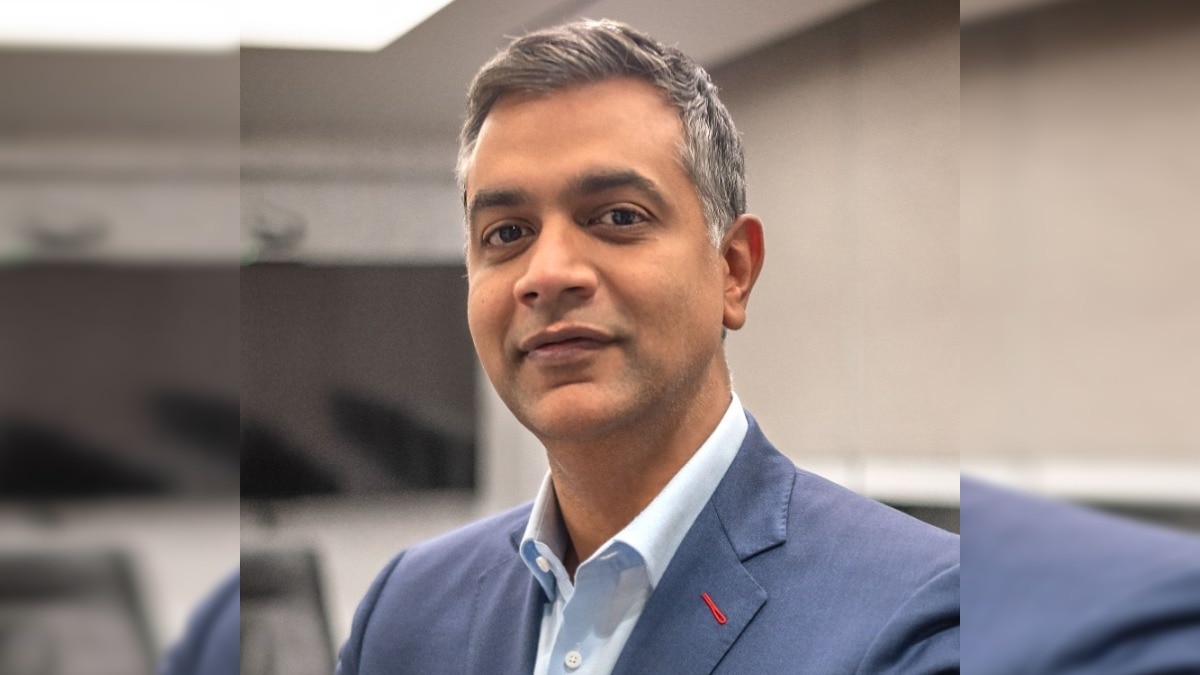
Artificial Intelligence is rapidly making its mark in banking operations, exemplified by Customers Bank CEO Sam Sidhu, who disclosed during the firm’s first-quarter earnings call that segments of his prepared remarks were voiced by an AI-generated version of himself.
Sidhu indicated that the prepared remarks taken on his behalf were delivered by his AI replica, marking a potential first in the context of public company earnings discussions.
This revelation comes as the $25.9 billion-asset bank accelerates its AI initiatives, having entered into a multi-year partnership with OpenAI. This collaboration aims to integrate engineers within the bank’s framework to automate critical functions such as lending and client onboarding, as reported by CNBC.
Sidhu views AI not merely as a tool for productivity but as a crucial factor linked directly to financial success. He noted that this initiative is projected to enhance the bank’s efficiency ratio from approximately 49 to the lower 40s, with expected improvements in returns as soon as next year.
The arrangement is designed as a co-development initiative, contrasting with traditional vendor partnerships. Sidhu stated that the objective is to collaboratively develop enterprise solutions that could later be offered to other banks. The focus is on creating a fully automated, agent-led workflow for lending, deposits, and payments.
For OpenAI, which has been increasingly focusing on financial services as a significant area for growth, this collaboration provides the opportunity for real-world implementation within a regulated banking landscape. Denise Dresser expressed pride in supporting Customers Bank in building a more intelligent operating model that enhances employee capability, improves customer service, and establishes new standards in regional banking.
From weeks to days
Customers Bank intends to implement AI agents across lending, deposits, and payments over the following six to twelve months. Sidhu mentioned that if successful, the period required to finalise a commercial loan, currently taking 30 to 45 days, could potentially reduce to about seven days, encompassing underwriting, document collection, and legal processes.
Onboarding for complex commercial clients, which often exceeds a day, could be streamlined to less than 20 minutes through the use of conversational AI and automated document management.
Sidhu articulated that with an autonomous agent, one essentially creates a digital worker capable of operating continuously.
The bank has been piloting AI internally, with approximately half of its software code now generated using AI tools. Sidhu highlighted that this has resulted in a savings equivalent to 28,000 hours of work, which parallels avoiding the hiring of around 15 full-time employees.
This presents an opportunity for potential hiring slowdowns while generating more revenue per employee, according to Sidhu.
Small bank, big advantage
In competition with larger institutions like JPMorgan Chase, which possesses trillions in assets, Sidhu maintains that smaller banks can adopt AI more swiftly due to less complexity and reduced regulatory burdens.
He asserted that smaller banks won’t be held to the same standards of frameworks as larger banks and that regulators are keen for regional lenders to compete effectively.
Having launched his career at Goldman Sachs in 2004, Sidhu mentioned that the bank is also exploring novel AI-native business lines that earlier would have been too expensive to develop, with smaller teams managing automated systems that take on tasks previously handled by extensive workforces.
This enhanced partnership extends an earlier relationship initiated in 2023, now involving the direct integration of OpenAI engineers into the bank’s operational workflows.
Sidhu concluded by stating that the advancements will benefit investors and customers alike, with regulatory bodies likely becoming more content over time as they observe a reduction in risk.