
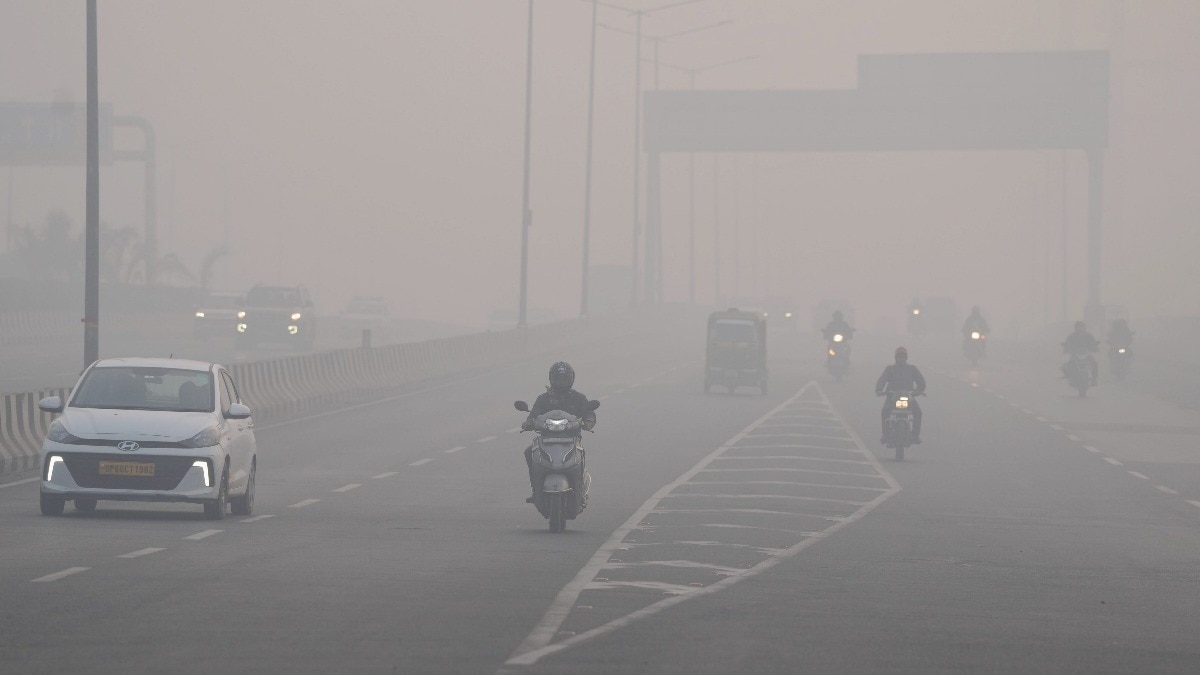
India’s pollution challenges, a pressing issue today, are viewed by a market expert as part of a historical trend present in many industrialising economies.
In a recent post on LinkedIn, Ritesh Jain, the Founder of Pinetree Macro and Nrizen, asserted that India’s heavy urbanisation marked by smog reflects stages experienced by Western countries and subsequently China. He explained that the difference today lies in the amplified impact observed through social media.
Pollution and Economic Growth
Jain argues that nations moving through the $3,000 to $5,000 per capita income range have consistently faced significant environmental degradation during rapid industrialisation.
Taking current-day Delhi as an example, where Air Quality Index (AQI) levels often hit “very poor” to “severe” categories (300-500), he stated that this scenario is frequently interpreted as proof of a “broken” development model. However, he emphasises that similar or worse conditions were present during previous industrial revolutions.
Historically, cities such as Manchester and Birmingham in the UK during the 19th and early 20th centuries were shrouded in coal smoke so thick that it reportedly obstructed sunlight for extended periods. London faced severe pollution and health crises, with the River Thames serving as an open sewer during periods of industrial growth.
The notorious 1952 “Great Smog” incident in London, often referenced as a critical moment for environmental policy, resulted in an estimated 12,000 deaths within weeks, at a time when global awareness was minimal.
Recent Comparisons: China
Jain also drew parallels with early 2000s China, when manufacturing-led growth led to extreme pollution in cities like Beijing. During peak periods, AQI readings reached hazardous levels over 500 and sometimes even 1,000, due to extensive reliance on coal-powered industries which resulted in considerable environmental and public health damage.
Industrial centres like Shenzhen illustrated the severity of this phase, marked by high steel and coal consumption supporting export-led growth. China later implemented comprehensive clean air regulations after 2013, reducing pollution significantly over the subsequent decade.
The Social Media Visibility Effect
Jain pointed out that what sets India apart is not just the magnitude of pollution but its extraordinary visibility today.
He noted that earlier industrial societies didn’t attract the same global scrutiny due to the absence of smartphones and social media that brought real-time documentation of daily conditions. India’s environmental issues are now continuously broadcasted online, shaping global perceptions instantly.
The Environmental Trade-off
Jain presented pollution as a challenging but historically persistent consequence of industrial growth, describing a typical cycle experienced by several economies: Growth → Increased income → Stricter regulations → Cleaner technologies → Environmental recovery.
He referenced mid-20th century Western environmental laws and China’s later regulatory measures as instances where wealth accumulation facilitated investment in cleaner infrastructure and enforcement. He suggested that India could be following a similar pathway as it transitions from a roughly $4 trillion economy towards a projected multi-trillion-dollar expansion in the future.
Responses from Netizens
Jain’s post sparked a vigorous online dialogue, with many participants questioning both the historical analogy and the assumption that pollution is an inevitable companion of development.
One commenter proposed that this reasoning leans heavily on the Environmental Kuznets Curve, a theory positing that environmental damage increases before decreasing with prosperity, but overlooks available technology today.
The opinion expressed was that modern India has access to green technologies, such as solar energy and electric vehicles, which were unavailable to 1850s Manchester. The current global climate crisis means that society can no longer afford the ‘pollute first, clean later’ approach without risking irreversible damage to the environment.
Another user pointed out structural differences between India and past industrialisers, arguing that India’s level of manufacturing is significantly lower than that of China or the UK during their highest pollution periods.
This user highlighted that India’s democratic structure often prioritises accountability over speed, suggesting a longer, more complicated cycle in balancing pollution with economic growth.
A further response questioned whether India’s pollution issues can be primarily attributed to industrialisation.
It was noted that while earlier economies faced pollution during rapid industrialisation, India’s challenges stem largely from consumption, indicating that manufacturing comprises only 13% of its GDP. This commenter expressed doubt that pollution could be resolved swiftly without profound structural changes.
In addressing the serious implications of pollution on quality of life during this transition, Jain positioned the phase as one that has historically coincided with significant economic opportunities, suggesting that such periods can be appealing to investors despite the challenges they pose to residents.