
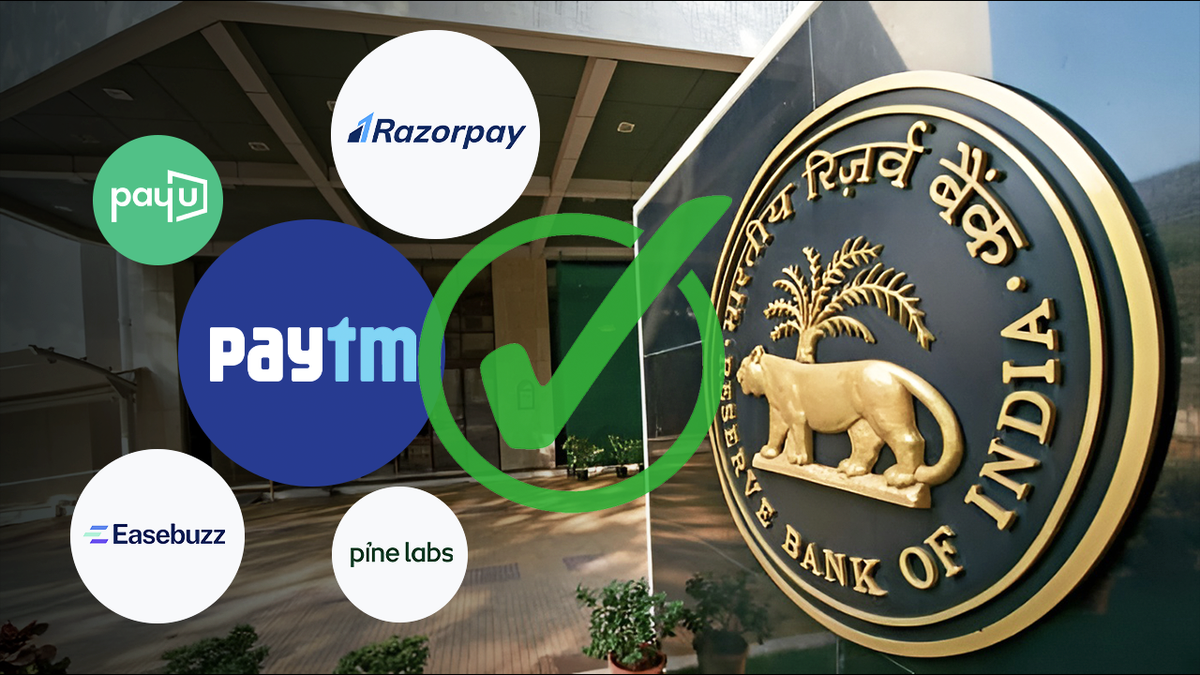
Fintech Regulatory Approvals in India 2025
The landscape of fintech in India is evolving, with the Reserve Bank of India (RBI) enhancing its regulatory approvals for fintech companies throughout the past year. As a result, various firms have obtained multiple payment-related licenses, leading to several companies receiving comprehensive authorization across different categories in 2025.
Recent Approvals and Licenses
In recent months, RBI has sanctioned both online and offline payment aggregation, as well as cross-border payment solutions for around six companies. This list features notable names such as Paytm, Razorpay, Easebuzz, PayU, Pine Labs, and Airpay. With these clearances, these firms are now authorized to provide a complete array of payment aggregator services, covering ecommerce transactions, in-store merchant payments, and cross-border payment flows.
On December 17, Paytm achieved RBI’s approval for offline and cross-border payment aggregation, completing its suite of payment aggregator licenses. Razorpay also received its cross-border payment aggregator license after prior approvals for both online and offline payment solutions. Easebuzz, PayU, and Pine Labs were granted permissions by RBI to offer comprehensive payment services across all domains. Airpay was subsequently added to this approved list after gaining authorization across all three areas.
Regulatory Framework and Compliance
These approvals are governed by the RBI’s revised 2025 Master Directions on Payment Aggregators, which distinguishes non-bank entities into online, offline, and cross-border categories, each with specified compliance, capital, escrow, and governance requirements. This regulatory framework aims to clarify regulations while striking a balance between fostering innovation and ensuring consumer protection and financial system stability.
Compared to previous years, the quicker approvals in 2025 mark a shift in RBI’s approach, as many payment aggregator applications were previously returned or held in abeyance due to compliance concerns. Between 2021 and 2023, RBI exercised increased scrutiny over escrow norms, governance, and data localisation, resulting in temporary restrictions for companies like Razorpay while their applications were under review. Paytm, on the other hand, received approvals in phases across different categories.
Industry Reactions
In a media statement, Rohit Prasad, MD & CEO of Easebuzz, remarked that the full-stack approval showcases the company’s commitment to a compliance-led approach in crafting a scalable and secure payment infrastructure. Razorpay co-founder Shashank Kumar expressed that acquiring the cross-border license enhances regulatory adherence and aids Indian businesses in international transactions. Although Paytm did not release a comment from its founder, filings indicate that the approval enables expanded merchant payment features.
Additional Licenses Granted
In a similar development, RBI has granted payment aggregator licenses to Mswipe for both online and offline transactions. This license enables Mswipe to deliver payment aggregation services across digital and in-store merchant scenarios.
Alongside these full-stack approvals, RBI has issued a number of additional licenses to other fintech and payment-focused enterprises during this timeframe. Infibeam Avenues has received the green light to operate as an offline payment aggregator. Additionally, Policybazaar’s PB Pay and MobiKwik’s Zaakpay have been authorized as online payment aggregators. In the realm of cross-border payments, companies like Skydo, Wise, EximPe, PayPal, and Worldline have secured RBI approvals to act as cross-border payment aggregators.
Moreover, RBI has given the nod to Junio and Infibeam for the issuance of prepaid payment instruments, adding yet another regulated entity in the consumer payments segment.
The surge in approvals signifies a broader expansion of licensed players across various layers of the payments value chain. In comparison to previous years, the velocity of regulatory clearances has increased significantly, allowing multiple firms to acquire either full-stack or category-specific authorisations in a condensed timeframe.