
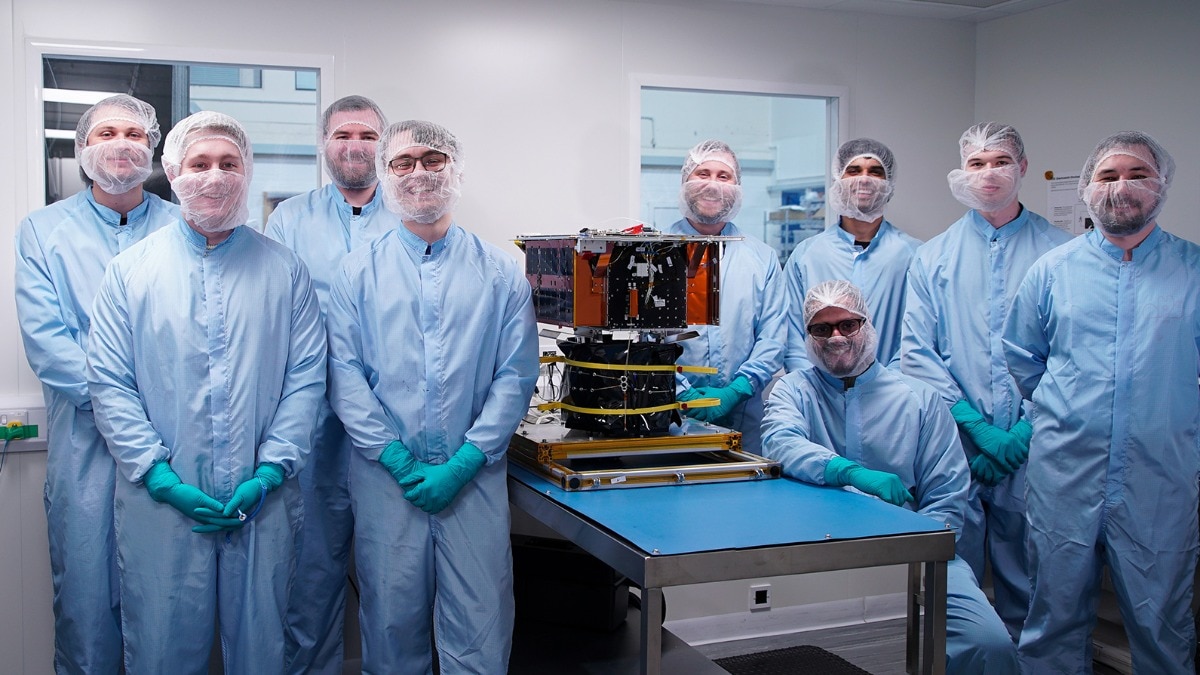
Orbital Manufacturing: Space Forge Advances Innovative Space Factory
A company in the UK is progressing towards making orbital manufacturing a viable option after successfully activating a furnace in its compact space factory.
Space Forge has shown that its microwave-sized facility, which was launched into orbit by a SpaceX rocket this summer, can reach temperatures nearing 1,000°C. The mission control team in Wales confirmed this achievement after receiving an image from within the furnace, revealing glowing plasma.
The Semiconductor Advantage
The intention of the company is to fabricate materials for semiconductors, vital components for computing, transportation, and communication infrastructures. The space environment offers two distinct benefits for this process:
Microgravity: In a zero-gravity setting, atoms can be arranged into a perfectly ordered three-dimensional structure, free from gravitational interference.
Vacuum: The inherent vacuum of space guards against contaminants entering the manufacturing process.
Josh Western, the CEO of Space Forge, elaborated on the importance of these conditions by stating that the ongoing work allows for the creation of semiconductors that are up to 4,000 times purer in space compared to current production on Earth. He mentioned that these chips would eventually serve in 5G towers, chargers for electric vehicles, and modern aircraft.
Scaling for the Futures
Following this successful demonstration, the team aims to develop a larger space factory capable of producing materials for up to 10,000 chips. However, a notable challenge persists: transporting the products back to Earth. Space Forge is in the process of developing a heat shield called Pridwen, named after King Arthur’s legendary shield, designed to safeguard the spacecraft from the extreme temperatures encountered during atmospheric re-entry.
Veronica Viera, the lead for payload operations at the company, expressed that witnessing the plasma image was one of the most thrilling moments of her career, highlighting that generating this heat is a core component of their manufacturing process.
A New Industrial Frontier
Space Forge is part of an expanding movement of companies striving to produce pharmaceuticals and artificial tissues in orbit. Libby Jackson, head of space at the Science Museum, remarked that while the industry remains in its early stages, its potential is extensive.
In-space manufacturing is a reality now, Jackson confirmed. By validating the technology, it paves the way for economically feasible products that can be manufactured in space, returned to Earth, and deliver benefits to everyone here. This prospect is truly exciting, she added.