
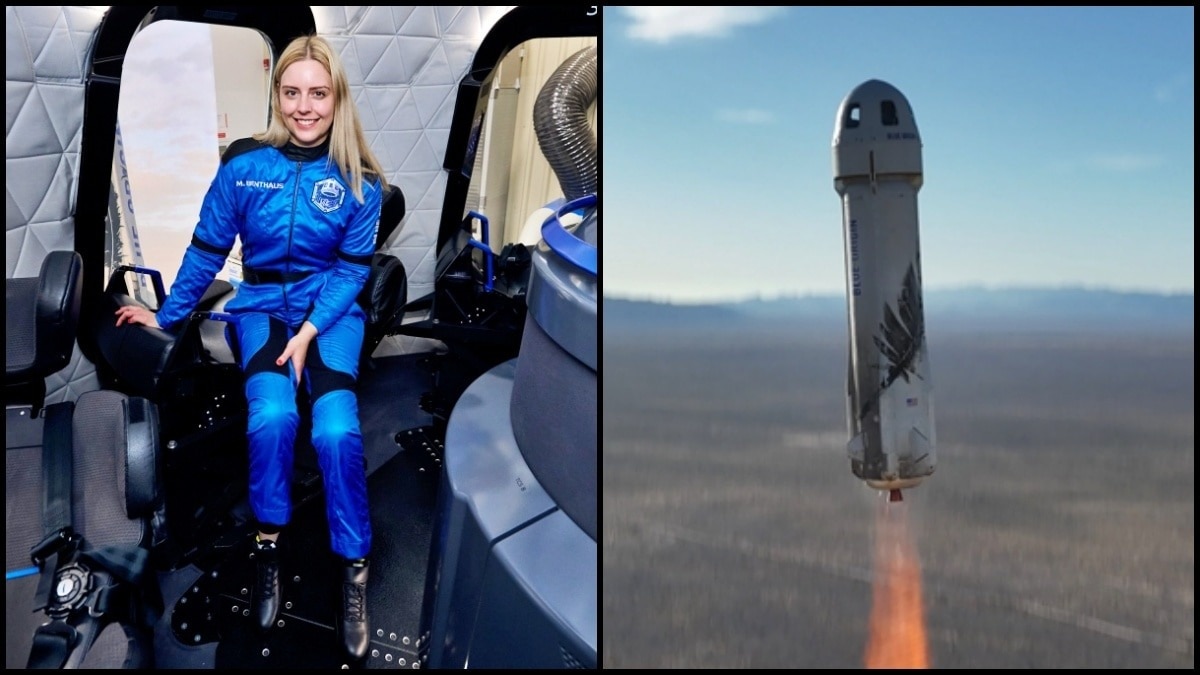
Michaela Benthaus, a 33-year-old aerospace engineer from Germany, has achieved a historic milestone as the first wheelchair user to journey into space. This significant mission occurred on Saturday, 20th December, aboard Blue Origin’s New Shepard rocket, marking an essential advancement for inclusivity in the realm of space exploration.
Benthaus, who is employed by the European Space Agency (ESA), ascended to an altitude of about 105 kilometres, surpassing the Kármán line, which is widely recognised as the boundary of outer space. The suborbital flight, identified as NS-37, took off from a private launch site in West Texas and lasted approximately 11 minutes.
A devoted space enthusiast, Benthaus faced a challenging journey to the stars, nearly interrupted seven years ago by a spinal cord injury from a mountain biking accident. Despite her reliance on a wheelchair, her commitment to a career in mechatronics and aerospace engineering persisted, eventually allowing her to become a member of the six-person crew on Jeff Bezos’s latest commercial flight.
Throughout the mission, Benthaus enjoyed several minutes of weightlessness. The company implemented several important modifications to the capsule to enhance her safety and mobility, such as installing a patient transfer board to assist her in moving between the hatch and her seat. She also used a special strap to secure her legs while floating, enabling her to fully appreciate the spectacular views of Earth.
After her capsule landed in the Texas desert, a jubilant Benthaus referred to the experience as the “coolest journey ever.”
She stated that one should never abandon their aspirations. She reflected that her accident highlighted how inaccessible the world remains. For a truly inclusive society, every aspect—including space exploration—must be accessible to all.
On this flight, Benthaus was joined by Hans Koenigsmann, a former SpaceX executive and fellow German engineer, serving as her designated emergency assistant.
The Future of Accessible Flight
Currently, the European Space Agency is preparing John McFall, a British amputee, for a prospective mission to the International Space Station. However, Benthaus’s private journey signifies the first instance of a person with paraplegia reaching outer space.
Experts in the industry predict that the success of the NS-37 mission will establish new standards for “parastronaut” safety protocols. By showcasing that high-performance space travel is conceivable without the conventional physical prerequisites, Benthaus has paved the way for a wider array of explorers to venture beyond Earth’s atmosphere.