
Tim Cook Steps Down as CEO: A Legacy of Innovation and Growth at Apple
Tim Cook, the Chief Executive Officer of Apple, announced his decision to step down at the age of 65, concluding more than a decade of leadership. His departure on September 1 of this year leaves behind a robust legacy characterized by the transformation of Apple into a powerhouse in services and silicon.
Tim Cook propelled Apple to be one of the most valuable companies in the world, enhancing its portfolio through initiatives such as Apple Music, iCloud, custom silicon production with M-series chips, and new wearables, while establishing a secure ecosystem across its services.
Key Achievements, Innovations, and Milestones of Tim Cook as Apple CEO
Building the Apple Services Ecosystem
Tim Cook assumed the CEO position in 2011 after the passing of Steve Jobs. He successfully expanded Apple’s service ecosystem, including apps and subscription offerings. During his leadership, the App Store became immensely lucrative, processing over $1.3 trillion in transactions.
Noteworthy services like Apple Pay, Apple Music, iCloud, and Apple TV+ contributed approximately $106 billion in revenue for 2025. This highly profitable ecosystem of applications, payments, and subscriptions is now a significant contributor to Apple’s overall earnings.
Revolutionising Apple with Custom Silicon
Under Cook’s leadership, Apple transitioned from Intel processors to its own silicon designed for Macs, initiating this shift with the M1 chip in 2020 for the MacBook Air, MacBook Pro, and Mac Mini. This innovation has evolved into the latest M5 series chips.
These custom chips have reportedly enhanced the speed and power efficiency of Mac devices, delivering extended battery life while surpassing the performance of competing chips from Intel and AMD during that period.
Introduction of Smart Wearable Products
Following its dominance in devices, ecosystem, and services, Apple ventured into the wearable technology market with the launch of the Apple Watch in 2015. Initially met with mixed reviews, Cook transformed the product into a vital health and fitness companion. Features such as ECG monitoring, blood oxygen tracking, and fall detection redefined its functionality.
In 2016, Apple disrupted the personal audio landscape with the release of AirPods, the company’s first “true wireless” earbuds. Now, Apple leads the wearable market with innovative features and offerings.
Spatial Computing and the Apple Vision Pro
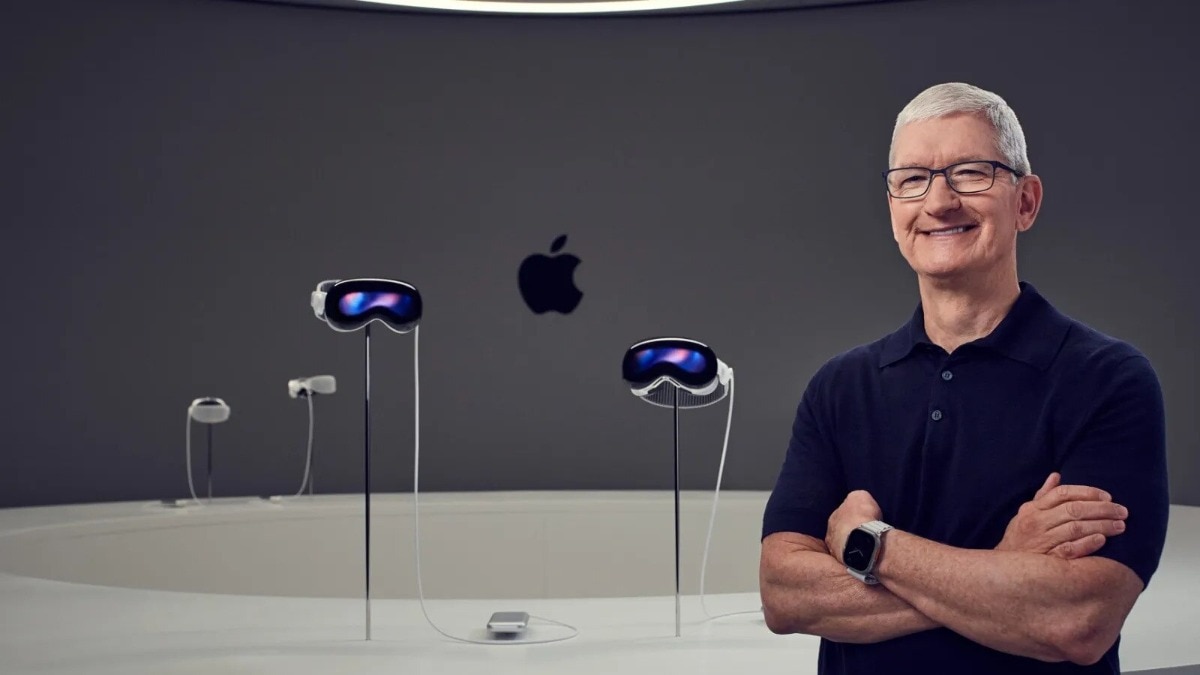
At the WWDC 2023 event, Apple showcased the Apple Vision Pro, marking the advent of spatial computing under Cook’s guidance. Priced at an eye-watering $3499 in the US, the product struggled to attract a mass audience but represented an initial move by Apple into spatial computing and next-gen interfaces.
Subsequently, reports emerged that Apple’s manufacturing partner, Luxshare, suspended production of the original device at the beginning of 2025 after distributing around 390,000 units globally.
Initiating Apple’s AI Era
In 2024, Apple embarked on its AI journey with the launch of Apple Intelligence. While significant breakthroughs have yet to be achieved, 2026 is anticipated to be a pivotal year for innovations in AI. Cook has characterised Apple Intelligence as a “personal intelligence system” that integrates generative AI with the user’s specific context.
In January 2026, Apple disclosed a long-term partnership with Google, enabling its next-gen foundational models to incorporate Google Gemini for complex cloud operations while safeguarding sensitive data within Apple’s Private Cloud Compute.
Apple’s $4 Trillion Milestone
Throughout Cook’s tenure, Apple consistently shattered market value records. In 2018, the company became the first to achieve a market capitalisation of $1 trillion. Apple subsequently reached a market value of $3 trillion in January 2022 and in 2025, became the third company to surpass the $4 trillion milestone.
As Tim Cook concludes his impactful leadership, the future of Apple will now be guided by John Ternus, who has been named Apple’s CEO and was previously the senior vice president of hardware engineering.