
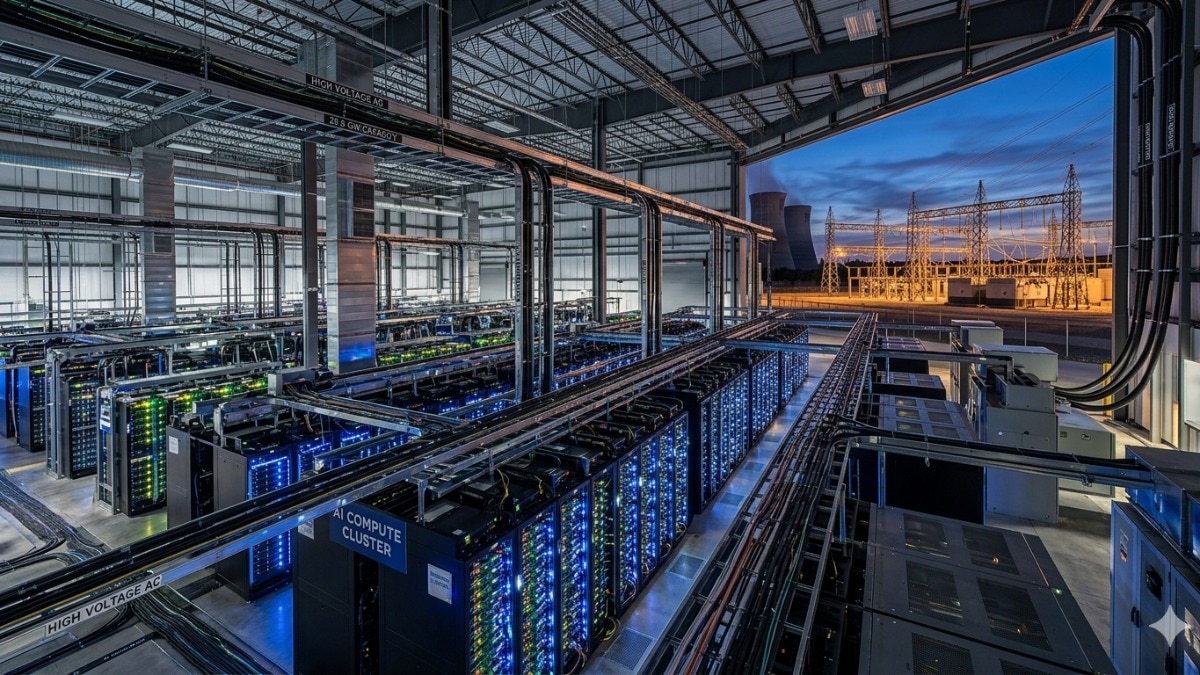
AI computing capacity has transformed the landscape of technology by enabling chatbots to respond to inquiries, generate images, and assist in research. While the advancements in machine learning are impressive, the essential role of a sophisticated infrastructure frequently goes unnoticed. Each interaction relies on an intricate, large-scale, and costly system that makes these capabilities feasible.
The AI Index 2026 report from Stanford University illustrates that the evolution of AI is no longer solely dependent on software and algorithm enhancements; the emphasis has shifted towards industrial-scale hardware infrastructure. It reveals that the global capacity for AI computing has surged by approximately 3.3 times annually, with projections indicating a remarkable 17.1 million GPUs in operation by early 2026.
This substantial growth compels governments and technology firms to reconsider energy supplies, electrical grids, and international supply chains. Companies such as Google, Microsoft, Amazon, and Meta are investing hundreds of billions of dollars into data centres and power infrastructure dedicated to AI.
Also read: Inside India’s first open-access quantum test beds in Amaravati built at half the global cost
H2: Surge in AI Computing Capacity
The research underscores that the scale of computing power available for AI is considerable and expanding swiftly. Since 2022, the capacity for AI computing has increased more than threefold annually. It now aligns with the equivalent of 17.1 million advanced AI chips like Nvidia’s H100.
The global landscape of AI computing capacity is predominantly influenced by major technology firms such as Nvidia, Google, and Amazon. The Stanford University study indicates that Nvidia accounts for over 60% of the world’s AI accelerator capacity, with Google and Amazon handling a significant portion of the remainder. These corporations are heavily investing in infrastructure to secure the necessary hardware, data centres, and related components.
The report highlights that the increase in computing capacity closely mirrors investment trends, with leading AI firms ramping up expenditures. The infrastructure sector has emerged as the fastest-growing focus of private AI investment.
Also read: India’s data centre capacity set to reach 2GW by 2026, backed by $30 billion in investments: Report
H3: Significant Energy Costs for AI Innovations
The report exposes the underlying costs linked to the rapid advancement of AI, primarily associated with the substantial energy demands required to run data centres, train sophisticated models, and maintain continuous computational operations.
By late 2025, AI data centres were consuming an estimated 29.6 gigawatts of global power, corresponding to New York State’s peak electricity demand. Of this total, approximately 11.8 gigawatts were allocated to AI chips, while the balance supported systems like cooling, networking, and other crucial data centre components.
However, AI infrastructure extends beyond mere powerful chips; modern AI data centres also rely on a comprehensive stack of components, forming a complex ecosystem of hardware and infrastructure that functions collaboratively behind the scenes.
These intricate systems rely heavily on technology firms such as Taiwan Semiconductor Manufacturing Company (TSMC), Nvidia, SK Hynix, Samsung Foundry, among others, each playing distinct roles in design, manufacturing, assembly, and additional processes.
As 2026 progresses, establishing and securing AI infrastructure has become a top priority. While the latest AI model rollouts capture public attention, the real competition occurs in semiconductor foundries and electrical substations, where enhancing capacity is essential to meet the growing power demands associated with AI.