
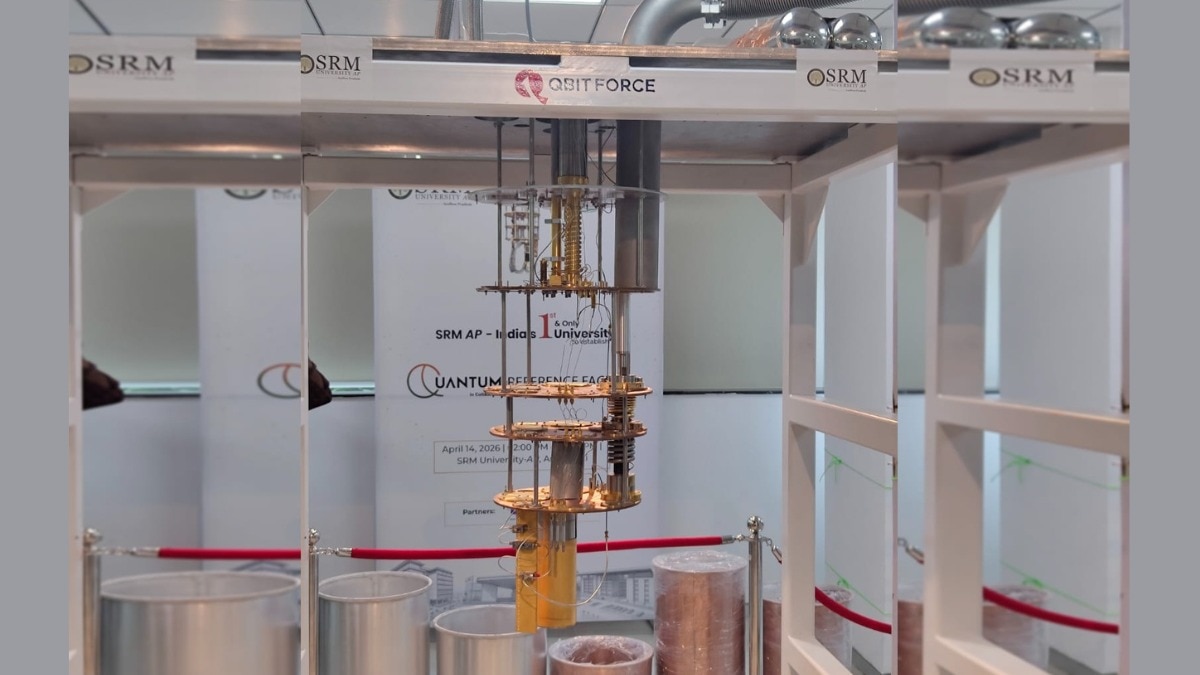
Quantum computer test beds in India have become operational in Andhra Pradesh, signifying a pivotal advancement in the nation’s pursuit of establishing a national quantum hardware ecosystem.
Constructed by QBit Force, these facilities are situated at two locations, SRM University in Amaravati and Medha Towers in Gannavaram. They serve as “test beds”, controlled environments for the experimentation, validation, and enhancement of quantum hardware.
Unlike most quantum laboratories worldwide, these systems feature open-access capabilities, enabling researchers, startups, and students to engage directly with the hardware.
QBit Force CEO Venkata Subramanian mentioned that the facilities were developed through an innovative community sourcing model, drawing components from various Indian manufacturers, including TIFR and DRDO.
Also read: Government expands National Quantum Mission startup cohort to 17, supports 9 new deeptech startups
From Closed Labs to Open Access
At the heart of this initiative is QU-414, a quantum characterisation facility managed by Qubitech. This lab provides hands-on access to quantum hardware that was once only found in a few elite laboratories globally.
Quantum computers are distinct from traditional computers in their information processing methods. They use qubits instead of bits (0s and 1s), allowing them to exist in multiple states simultaneously. This capability enables them to solve intricate problems with greater efficiency, but it also renders them exceptionally susceptible to external interference.
To maintain stability, these systems function at incredibly low temperatures, colder than outer space, around 10 millikelvin, approximately minus 273 degrees Celsius, employing specialised equipment known as dilution refrigerators.
Designed for Modifications
What differentiates the Amaravati facilities is their open-hardware architecture. In most quantum labs, systems are sealed and immutable. However, here, components can be removed, substituted, and retested, permitting researchers to explore various configurations.
QU-414 is described by Prudhvi Pinnaka, Founder and CEO of Qubitech, as not merely a testing facility but also a training centre. He indicated that they are creating affordable revenue models aimed at democratizing quantum computer testing and validation.
Also read: AI investments must be paired with quantum-safe security, according to IBM’s Subhathra Srinivasaraghavan.
Reducing Accessibility Barriers
Cost considerations have been a significant factor in the establishment of these facilities. QBit Force CEO Subramanian highlighted that local sourcing of components contributed to reducing the overall cost by nearly 50%, bringing it down to around Rs 15 crore.
In contrast, accessing similar facilities abroad could incur costs of up to 2,000 euros per day, thus limiting accessibility for most researchers and startups. By bringing such capabilities to India, these test beds aim to enhance the feasibility of quantum hardware experimentation.
The facility also utilizes FPGA-based control systems, versatile chips that assist in managing and interpreting quantum signals, thereby minimising the dependence on large and expensive equipment.
Expanding Beyond Quantum Processors
The facility’s scope goes beyond merely quantum chips. It encompasses quantum hardware development, material characterisation, and next-generation semiconductor research.
A primary focus is cryogenics, or ultra-low temperature engineering, which plays a crucial role in preserving stable quantum states. Additionally, it encompasses the integration of “warm” and “cold” systems, linking room-temperature electronics with hardware functioning near absolute zero.
Together with the Medha Towers facility, the SRM University test bed aims to prioritise component testing and training, thus broadening access for students and early-stage researchers.
Cultivating a Domestic Ecosystem
The overarching goal is to foster a local ecosystem centred around quantum technologies. The director of the Andhra Pradesh State Quantum Mission, CV Sridhar, stated that nearly 85% of quantum hardware components can currently be produced within the country, with a roadmap to fully localise production.
This initiative also aligns with India’s National Quantum Mission, which seeks to develop capabilities in quantum computing, communication, and sensing.
A Long-Term Vision
The test beds form part of a broader initiative under the Amaravati Quantum Valley project, which includes plans for a research campus and the rollout of a 133-qubit quantum computer in collaboration with IBM, Tata Consultancy Services, and Larsen & Toubro.
The state aims to create 100 quantum algorithms by 2028 across various sectors, such as finance, logistics, energy, cybersecurity, and materials science, through a Quantum Innovation Centre that will involve faculty and researchers from IITs.